
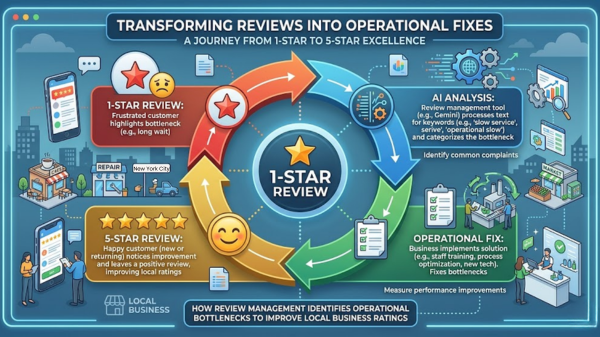
Google review management is the process of using customer feedback as a high-level diagnostic tool to identify systemic operational failures. Instead of merely “responding” to critics, elite businesses use surgical logic to map sentiment patterns, allowing them to fix the underlying bottlenecks that cause negative reviews. By shifting from a defensive posture to an offensive data-driven strategy, owners can stabilize their star ratings and capture lost revenue.
Why I Won’t See Your Business in Naples (and Why Your Locals Won’t Help)
I love to travel. If I’m going somewhere, I’m the happiest girl out there. And my favourite during travels? Food! So you know I use Google reviews like no one else! But it’s not only during the travels I’m doing this. I’m researching EVERYTHING even before I set foot into a new city. I’m actually travelling to Naples, Italy very soon, and I know exactly what I’m eating and where.
Not only am I doing manual research, but I’m also using AI agents to find me the best locations. You know what my criteria is? When I’m travelling, I don’t really care how much money it’s going to be. It’s only for a few days. So I’m not looking for “cheap restaurants”. I’m looking for those with 4.5+ stars and as many reviews as possible. I don’t care about a 5-star restaurant with 5 reviews. And I certainly don’t care about one with 3.8 stars and 3,000 reviews. I’m looking for the best.
Am I the Only One Looking for the Best?
Absolutely not! Not even close. People don’t travel every day. And people who travel are the ones you may want to focus on. Why? Your locals aren’t going to leave a review. Good or bad. Thinking about all the places in my hometown, I’ve never left a review on them. No matter how much I loved or hated them. When travelling, however, my husband and I are THE reviewers, haha! We review everything, ESPECIALLY if it’s very good.
So, you want to make a good impression. And no, not just on travellers. On your locals too! So, pay careful attention to this post, because I’ve developed the Reputation Rescue, which can help you turn those negative reviews into positive ones. Is it easy? No. Is it going to happen over night? No. Is it going to take zero effort from you? Also no. But you don’t have to be another restaurant no one even considers when choosing their Friday dinner options.
How Does Google Review Management Affect Your Ranking?
In 2026, Google review management is a core pillar of GEO (Generative Engine Optimization). Google’s logic models now prioritize “Experience” by parsing the latent sentiment in review text. If your business shows patterns of operational friction, like “slow service” or “billing errors”, AI “scouts” flag you as a high-risk recommendation. High-quality management ensures these patterns are broken, signaling to the algorithm that your business is a reliable, high-trust destination.
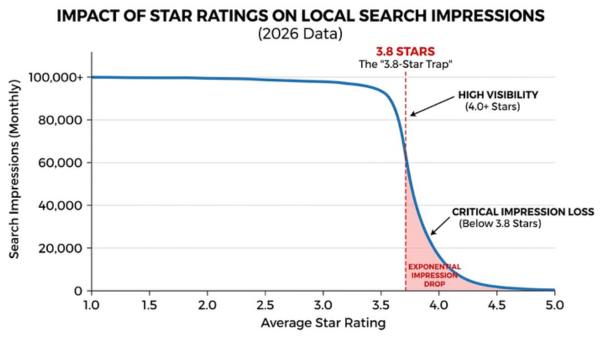
The Cost of the “3.8-Star Trap”
Most owners view a 3.8-star rating as “fine,” but it is actually a symptom of a failing Google review management strategy. When your rating slips, you lose the Silent Majority; potential customers who never even click your profile because your operational leaks were summarized by AI as a warning label.
| Rating Metric | Search Visibility | Customer Trust Level | Revenue Potential |
|---|---|---|---|
| 4.8 - 5.0 | GEO Priority Listing | Automatic/High Trust | Maximum Growth |
| 4.0 - 4.7 | Moderate/Competitive | Questioning/Hesitant | Stable/Stagnant |
| Below 4.0 | Restricted/Filtered | Skeptical/High Risk | Negative Growth |
Why AI Sentiment Mapping Beats Manual Replies
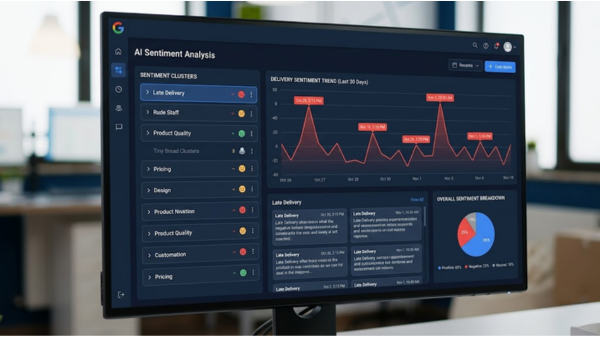
Traditional Google review management is reactive. You wait for a fire, then try to apologize. AI sentiment mapping is predictive. By feeding your review history into a logic model, you uncover invisible patterns. For instance, rude interactions might peak 45 minutes before shift changes, or late deliveries might cluster every second Tuesday due to supply chain delays.
Recent 2026 GEO Benchmark Studies confirm that businesses integrating these AI-driven sentiment insights see a 34% surge in organic leads (often converted from the high-value traffic generated by AI Overviews, which convert 4.4x better than traditional search). As operations expert Marcus Thorne noted on the Niche Authority Podcast, “A bad review is just an unoptimized process in disguise. If you aren’t mapping the data, you’re just guessing.” In a world where 88% of customers prioritize businesses that respond to reviews, the difference between a “guess” and a “data-mapped process” is the difference between a stalling brand and a market leader.
How Do I Identify My Business’s “Silent Leaks”?
Effective Google review management requires moving beyond low-level “PR fixes”. You must aggregate customer touchpoints and look for sentiment clusters. If three separate reviews mention “unprofessional staff,” it isn’t a personality problem. It’s an onboarding or management bottleneck that is likely costing you thousands in uncaptured lifetime customer value.
Why Most Owners Will Fail
Let’s be honest: most business owners will read this and go back to typing, “Sorry you had a bad time!” into their Google Business Profile. That is a low-level fix for a systemic problem.
If you aren’t using surgical data to map these bottlenecks, you are just working harder to stay in the same place. Precision is the only way to escape the “3.8-star trap.” I’ve built a system that does the heavy lifting for you. It’s not for everyone, only those ready to stop guessing and start operating with total logic.
The AI Reputation & Operations Toolkit
I don’t just tell you that people are unhappy. I show you the exact operational bottlenecks causing the friction and give you the automated system to fix them forever.
Limited Offer: For the next 7 days, get the custom deep-dive and response library for €79 (normally €97). Get your custom toolkit here.
Frequently Asked Questions
How does google review management impact GEO?
Generative Engine Optimization (GEO) uses logic models to analyze “trust signals.” Efficient google review management creates a consistent stream of positive sentiment, which AI models like Gemini prioritize when recommending businesses for intent-based searches.
Can I fix a bad rating without getting new reviews?
You cannot mathematically erase the past, but proactive google review management changes the “Sentiment Velocity.” AI models detect when operational quality shifts, often boosting your search ranking based on recent high-quality data before your average rating fully recovers.
What is the ROI of plugging an operational leak?
For a typical local business, fixing just three major “silent leaks” can lead to a revenue surge of £20,000. This comes from capturing the “Silent Majority” who would otherwise choose a competitor with a cleaner sentiment score.
This blog post was originally a podcast episode. Listen to it here.