
We have all heard the standard warning: “Don’t Google your symptoms”. Usually, this is good advice because a search engine can often lead to unnecessary paranoia or make a minor issue seem life-threatening. However, as technology evolves, the conversation around AI for medical diagnosis is shifting because AI can detect things and make connections based on training data that doctors might miss.
While AI should never replace professional medical care, there are documented cases where AI has successfully identified diseases, including specific cancers, that doctors initially missed. Today, I want to share a personal story about how a single prompt did what two decades of specialists could not.
A 20-year medical mystery
Since I was 12 or 13 years old, I’ve been struggling with a recurring, painful skin condition. Twice a year, typically in late spring and fall, tiny, water-filled blisters would appear on my hands and feet. They were incredibly itchy, red, and would eventually dry out, crack and scale over several weeks.
For 20 years, I visited countless dermatologists in both the private and public sectors. I was given everything from topical steroids and custom pharmacy creams to infusions and herbal teas. No one knew what was going on, and I eventually stopped seeing doctors because the treatments never helped.
How I used AI for medical diagnosis
A few weeks ago, the condition flared up again. Instead of heading back to a specialist, I decided to test the potential of AI for medical diagnosis. I described exactly what it was, what it looked like, and how frequently it happened.
The response was immediate: Dyshidrotic eczema.
I had never heard those two words in 20 years of medical appointments. After researching the condition, I realized it was a perfect match for everything I had experienced since childhood. While there isn’t a “cure,” simply having a name for the condition after two decades of confusion was life-changing.

How to use AI for medical diagnosis safely
My story highlights the opportunities AI for medical diagnosis can provide by making connections that humans might overlook. However, using AI for health requires strict guardrails to ensure your safety.
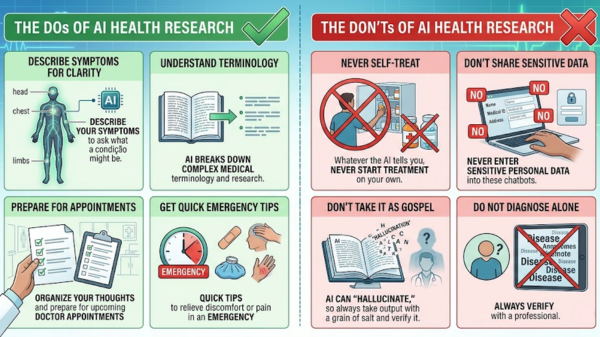
The DOs of AI health research
Describe symptoms for clarity: You can describe your symptoms to ask what a condition might be.
Understand terminology: AI is excellent at breaking down complex medical terminology and research.
Prepare for appointments: Use AI to help organize your thoughts and prepare for upcoming doctor appointments.
Get quick emergency tips: Use it for quick tips to relieve discomfort or pain in an emergency.
The DON’Ts of AI health research
Never self-treat: Whatever the AI tells you, never start treatment on your own.
Don’t share sensitive data: Never enter sensitive personal data into these chatbots.
Don’t take it as gospel: AI can “hallucinate,” so always take its output with a grain of salt and verify it with a professional.
The importance of context and professional verification
If you decide to explore AI for medical diagnosis, the quality of the answer depends entirely on the context you provide. Be as detailed as possible about your history and symptoms to get the most accurate results.
Most importantly, take your findings to your doctor. Use AI as a starting point, a way to become a better advocate for your own health, but let the professionals make the final call.
Have you ever used AI to help solve a personal problem? I’d love to hear your experiences in the comments.
For more practical ways to use AI as a thinking partner, check out my Tools Library or follow me on Instagram @GPTGuides.
This blog post was originally a podcast episode. Find more about my podcast here.
Disclaimer: I am not a medical professional. The information in this post is based on personal experience and should not be taken as medical advice. Always consult with a qualified healthcare provider for any health concerns or before starting any treatment.
FAQ: How to safely navigate AI for medical diagnosis
Can AI for medical diagnosis replace a doctor?
No, AI cannot replace a doctor. While AI for medical diagnosis excels at pattern recognition and scanning vast datasets to suggest possibilities like Dyshidrotic eczema, it lacks the physical examination capabilities and clinical judgment of a licensed professional. Always use AI as a “thinking partner” to prepare for appointments, not as a final authority.
What are the risks of using AI for health symptoms?
The primary risks are medical “hallucinations” and data privacy concerns. AI models can occasionally generate confident but incorrect medical information. Furthermore, entering sensitive health data into public AI tools can compromise your privacy. Use specific symptom descriptions but avoid sharing personally identifiable information (PII).
How do I get the most accurate medical information from an AI?
To maximize accuracy, provide detailed context including symptom duration, triggers, and physical appearance. High-quality prompts lead to high-quality outputs. Instead of asking “What is this rash?”, describe it as “recurring, water-filled blisters on hands that appear in spring.”