
Listen to the ChatGPT Boycott podcast episode on Spotify.
I’ll be honest with you… I’ve been a ChatGPT user since the beginning. My entire brand is built around it. So when the #QuitGPT movement, with the whole ChatGPT Boycott, started exploding on Instagram and Reddit, my first instinct was to scroll past it. Another internet outrage cycle, I thought. It’ll blow over.
It hasn’t blown over. And the more I looked into it, the more I understood why.
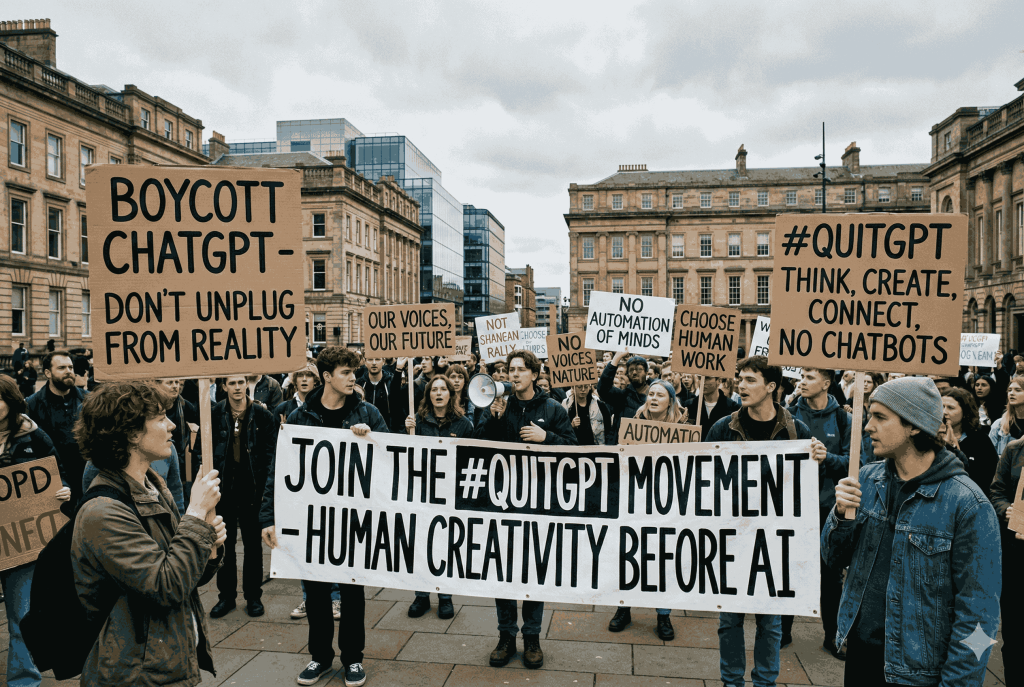
According to Tom’s Guide, over 700,000 people are currently boycotting OpenAI and canceling their ChatGPT Plus subscriptions. At $20 a month, that’s roughly $1.4 million in monthly revenue that OpenAI is at risk of losing if those users keep their word. The hashtag #QuitGPT is trending, the Reddit threads are long and angry, and for the first time, I’m genuinely considering joining them. Here’s the full story.
What Sparked the ChatGPT Boycott in the first place
The match that lit this fire was a political one. Greg Brockman, the President of OpenAI, made a personal contribution of $25 million to MAGA, Inc. For a user base that skews heavily toward younger people and creative professionals, this felt less like a personal political choice and more like a statement about where the company’s loyalties lie. The backlash was swift and the hashtag spread fast.
But politics was just the beginning.
The ethical red flags fueling the #QuitGPT Movement
Once people started looking, they found more to be uncomfortable about. It emerged that ICE (U.S. Immigration and Customs Enforcement) uses a ChatGPT-powered tool for hiring and screening processes. For a lot of users, that crossed a clear line. The idea that your $20/month subscription might be indirectly funding immigration enforcement infrastructure isn’t a comfortable one.
On February 28th, Sam Altman tried to get ahead of it. He posted on X inviting people to ask him anything about OpenAI’s work with the Department of War. The responses were not warm. Most users felt his answers dodged the real concerns rather than addressing them, and the whole exercise ended up feeling like damage control that didn’t control much.
[IMAGE: Your screenshots from Sam Altman’s X AMA — ideally 2–3 showing the most-liked critical replies or the questions he visibly avoided answering]
The ChatGPT Boycott’s third reason
Here’s the thing that I think actually tipped the scales for most people, myself included: ChatGPT just isn’t as good as it used to be.
I don’t mean that lightly. I’ve used this tool almost every day for years. But lately, something has shifted. The responses feel different: more cautious, more hedged, sometimes weirdly formal or repetitive. It hallucinates more than it used to, especially if your prompt isn’t air-tight. And it refuses things it would have happily answered 18 months ago, often with a kind of preachy explanation that makes you feel like you’ve been sent to the principal’s office.
For a $20/month tool, that’s a problem. The political stuff gave people a reason to leave. The quality decline gave them the excuse.
Where are #QuitGPT users actually going?
The good news is that ChatGPT Boycott doesn’t mean leaving AI altogether. The three main destinations right now are:
- Claude by Anthropic is the one I’ve been testing most seriously. I’ll admit, as someone whose brand literally has “GPT” in the name, this is a slightly awkward thing to say… but Claude genuinely impressed me. It fixed a complex problem for me faster than ChatGPT did (we worked on this problem for a few hours and got nowhere, while Claude fixed it in about 15 minutes), the responses feel more natural and it doesn’t have that over-cautious, refuse-first energy that’s made ChatGPT frustrating lately. Anthropic has also been more transparent about their safety approach, which matters right now.
- Google Gemini is the natural landing spot if you’re already living inside Google’s ecosystem. It’s powerful, improving quickly, and the multi-modal capabilities are genuinely useful for creative work.
- Perplexity AI is worth a serious look if research is your main use case. It operates more like a hybrid search engine than a pure chatbot, and it cites its sources, which goes a long way toward solving the hallucination problem.

None of them are perfect replacements. The feature I’m going to miss most, if I do switch, is ChatGPT Tasks: the scheduling and automation functionality. I’m not sure anyone else has a clean equivalent yet. That alone might keep me around a little longer while I figure it out. But I am doing some research and it looks like there might be SOME that are pretty close.
Thinking of joining the ChatGPT Boycott? Read this first
If you’re seriously considering making the switch, here’s what I’d recommend before you pull the trigger:
Export your data first. Go to Settings → Data Controls → Export Data. You’ll get a full archive of your conversations. Don’t skip this step, especially if you’ve been using ChatGPT for years. Here’s OpenAI’s official guide on exporting your data.
Test your actual workflows before committing. Don’t just ask Claude or Gemini fun questions. Run the specific prompts you use every week and see how the output compares. That’s the only honest test. If you want a prompt for every single day of the year, check out the 365 prompts for the year.
Give yourself a few weeks. A tool that cost you $20/month has probably become habitual in ways you haven’t noticed yet. The adjustment takes time.
Cancel, don’t just pause. If you’ve made the decision, Settings → My Plan → Cancel Plan. It takes effect at the end of your billing cycle.
The bigger picture: What the ChatGPT Boycott really means
The #QuitGPT movement isn’t really about one donation or one government contract. It’s about a user base that has grown up. People aren’t just grateful AI exists anymore… they’re asking who built it, what it’s being used for and whether the company behind it shares their values.
OpenAI built something extraordinary. But it turns out that being first isn’t enough if you lose the trust of the people who made you dominant. Claude, Gemini and Perplexity are ready and waiting, and for the first time, they’re genuinely competitive. Wired has a good breakdown of how the competitive AI landscape has shifted if you want to go deeper on this.
I haven’t made my final decision yet. I’m giving myself a few more weeks of testing. But I’ll be honest… for the first time since I started this, I’m not assuming I’ll stay.
Are you switching? Still on the fence? Let me know in the comments and check back soon, because I’ll be posting a full head-to-head comparison of ChatGPT, Claude, Gemini and Perplexity once I’ve had enough time to test them properly.
If you want to hear the podcast episode I recorded on this topic, you can check out the GPTGuides Podcast page.