
ChatGPT is often marketed as a writing tool: emails, blog posts, captions, essays… But for most people, writing is not the real problem. The real problems are messier: too many things to think about at once, decisions that feel small but drain your energy, a constant sense of being behind, plans that exist only in your head or thoughts looping without resolution. This is where ChatGPT tasks for everyday life become genuinely useful. Not as a replacement for thinking or a magic productivity hack, but as a quiet, reliable thinking partner that helps you plan, organize, and offload mental clutter.
This article focuses on practical, everyday uses of ChatGPT for real life. You do not need advanced prompt engineering skills. You do not need to use it every hour. You just need to know what to hand over to it.

Everyday problems ChatGPT can help with
Most people open ChatGPT and freeze because they think they need a “good prompt.” In reality, ChatGPT is best used when you already feel slightly overwhelmed.
Here are common everyday problems where ChatGPT tasks for everyday life make sense:
-
“I have a lot to do but I don’t know where to start.”
-
“I keep thinking about this decision and can’t move on.”
-
“My week feels chaotic even though nothing big is happening.”
-
“I’m carrying too many small responsibilities in my head.”
-
“I need to think this through, but talking to people feels exhausting.”
ChatGPT works well here because it does two things humans struggle with:
-
It holds information without emotional charge
-
It forces your thoughts into visible structure
You are not asking ChatGPT to decide for you, you are asking it to help you see clearly. That distinction matters.
ChatGPT for Planning Your Day and Week
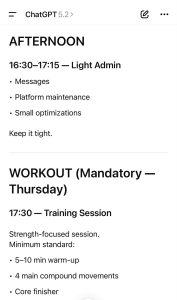
Planning is one of the most underrated ChatGPT tasks for everyday life. Not because it creates perfect schedules, but because it helps you move from mental chaos to something you can react to. Most people try to plan inside their head. That is exhausting.
Daily planning with ChatGPT
A good daily plan is not about doing more. It is about reducing friction.
Instead of asking ChatGPT for a generic to-do list, give it context, constraints, and priorities.
Example prompt:
Why this works?
Because you are not asking for productivity advice, but for for sorting and prioritization. That way you stay in control of what actually gets done.
Weekly planning with ChatGPT
Weekly planning is where mental load usually explodes. Work, personal life, errands, social commitments, admin tasks. Everything competes for attention. ChatGPT tasks for everyday life are especially useful here because the model does not forget or get overwhelmed.
Example prompt:
Act as a weekly planning assistant focused on balance and clarity. Context: – This week includes [work/school/family/rest]. – Non-negotiable commitments: [list]. – Things I want to make space for: [rest, movement, creativity, errands, etc.]. Here is a brain dump of everything I think needs to happen this week: [list] Please: 1. Sort tasks into: must-do, nice-to-do, optional. 2. Suggest a loose weekly structure (not hourly). 3. Highlight days that might be overloaded. 4. Recommend where rest or buffer time should go. 5. Point out tasks that could realistically wait until next week.
ChatGPT for thinking things through
Some thoughts do not need advice, but space. One of the most powerful ChatGPT tasks for everyday life is using it as a thinking mirror. You externalize thoughts so you can actually examine them.
This is especially helpful when you keep replaying the same scenario, feel stuck between options or know something feels “off” but can’t name what and/or why.
Thinking without being judged
ChatGPT does not interrupt, rush, or minimize. That makes it useful for reflection.
Example prompt:
Act as a neutral thinking partner. I want to think through the following situation: [describe the situation in detail] Please: 1. Summarize what the core issue seems to be. 2. Identify what is within my control and what is not. 3. Reflect back possible underlying concerns or fears. 4. Ask me 3 clarifying questions that would help me think more clearly. 5. Give me a list of pros and cons. 6. Do not give advice yet.

ChatGPT for mental load and decision fatigue
Mental load is about too many small decisions:
- What to cook
- When to schedule something
- Whether to say yes
- How to phrase a message
- What to do first
ChatGPT tasks for everyday life shine when you let it handle pre-thinking.
Reducing decision fatigue
You do not need ChatGPT to decide for you. You need it to narrow the field.
Example prompt:
Act as a decision clarity assistant. Decision I am stuck on: [describe the decision] Constraints: – Time: [urgent/not urgent] – Energy: [low/medium/high] – Values that matter here: [list] Please: 1. Break this decision into smaller parts. 2. List realistic options (not idealized ones). 3. Outline pros and cons in plain language. 4. Highlight which option aligns best with my stated values. 5. Point out if this decision actually needs to be made now.

When ChatGPT is not the right tool
Not every problem should be handed to AI. ChatGPT tasks for everyday life work best when the task is cognitive, organizational, reflective or low emotional risk. ChatGPT is not the right tool when you need emotional validation from a human, you are in acute distress, the issue involves medical, legal or crisis-level decisions, or you are avoiding necessary conversations with real people.
Think of ChatGPT as a notebook that talks back and never judges you. It’s not a therapist, an authority or a replacement for real support.
Brain dumps vs structured thinking
Most people start with a brain dump. That is good, but incomplete. A brain dump releases pressure, while structured thinking creates movement.
Brain dump prompt
You can write this or you can turn on ChatGPT’s voice mode and do this:
I want to do a complete brain dump. Please do not organize or summarize yet. Just acknowledge and hold the information. Here is everything on my mind right now: [list everything freely]
This step matters because it removes the fear of forgetting.
Turning a brain dump into structure
Then do this:
Simple prompts that actually work
You need specific, grounded prompts.Here are simple structures you can reuse daily.
Prompt for clarity
Prompt for overwhelm
Prompt for organizing thoughts
These prompts work because they reflect real human states.
Why ChatGPT tasks for everyday life actually stick
The reason people stop using productivity tools is emotional friction.
ChatGPT feels different because it adapts to your context, never shames you for being inconsistent (unless you tell it to), works in short bursts, and it meets you where you are. If used intentionally, ChatGPT tasks for everyday life become a background support system. Not something you “do,” but something you use when needed. You just need a bit more space to think.
Prompt for PRO users
If you want to go beyond one-off prompts and actually turn ChatGPT into a structured daily planning system, I built something for that.
It’s a complete prompt setup that turns ChatGPT into your daily and weekly planning engine. You paste it once, answer a few setup questions, and it starts generating realistic to-do lists based on your goals, commitments and real capacity.
If you’re on a paid plan, you can automate it using Tasks, so it sends your plan to your inbox automatically. If you’re on the free plan, you can still use the system manually by running it each day. The structure works either way.
It also includes calibration and reset prompts, so if the workload feels off or you fall behind, you adjust instead of quitting.
If that sounds helpful, you can read more about it here: The Ultimate Productivity System.
I use this as an experiment to see how my life is going to change when ChatGPT is in control of it, and I have to say this: I’ve never been more productive, my house has never been cleaner, and I have never been able to actually fit workouts in my week regularly, haha!
I’m telling you, this is a game-changer!
Final thought
If you only use ChatGPT to write things, you are missing its most human use: Planning, thinking, organizing and reducing mental noise.
Those are the tasks that quietly change how your days feel. If you want to learn more about ChatGPT tasks, you can check out the blog post Everything You Need to Know About ChatGPT Tasks.
Happy planning!